
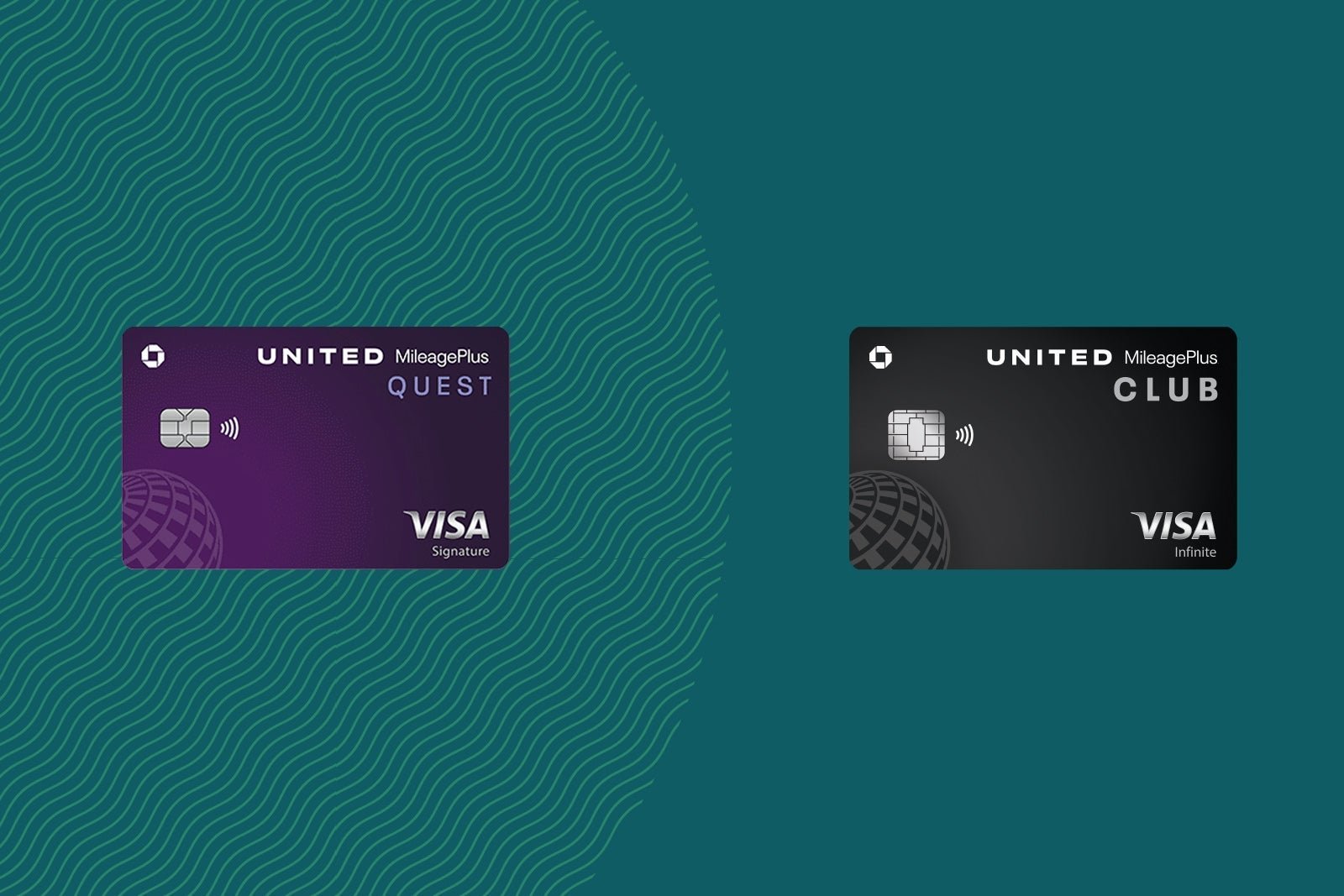
United loyalists have two strong ways to upgrade their travel — but only one comes with a key to the lounge.
The United Quest℠ Card (see rates and fees) offers valuable credits and travel perks, while the premium United Club℠ Card (see rates and fees) adds lounge access and richer benefits.
If you’re looking for United Club access and a faster path to status, the Club Card is a stronger choice, whereas the Quest better suits travelers who want United perks without paying for access they may not use.
Here’s how the cards compare in terms of credits, earning rates and travel perks so you can decide which one deserves a place in your wallet.
United Quest Card vs. United Club Card: At a glance
| Card | United Quest Card | United Club Card |
|---|---|---|
| <strong>Annual fee </strong> | $350 | $695 |
| <strong>Authorized user fee </strong> | $0 | $0 |
| <strong>Welcome bonus</strong> | Earn up to 90,000 bonus miles and 500 PQP: Earn 500 PQP after your first purchase and 80,000 bonus miles after spending $4,000 on purchases in the first three months from account opening. Plus, earn 10,000 bonus miles after adding an authorized user in the first three months from account opening. | Earn up to 100,000 bonus miles: Earn 90,000 bonus miles after spending $5,000 on purchases in the first three months from account opening. Plus, earn 10,000 bonus miles after adding an authorized user in the first three months from account opening. |
| <strong>Lounge access</strong> | None | United Club membership for the primary cardholder |
Quick picks by traveler type
| Best for | Card |
|---|---|
| Travelers seeking checked-bag and award-booking benefits at a lower annual fee | United Quest |
| Heavy spenders trying to earn more Premier qualifying points (PQPs) through card spending | United Club |
| United flyers who regularly visit United Clubs | United Club |
| United flyers looking for automatic TravelBank cash | United Quest |
United Quest Card vs. United Club Card: Welcome bonus
The United Quest card offers up to 90,000 bonus miles and 500 PQP: Earn 500 PQP after your first purchase and 80,000 bonus miles after spending $4,000 on purchases in the first three months from account opening. Plus, earn 10,000 bonus miles after adding an authorized user in the first three months from account opening.
Based on TPG’s November 2026 valuations, these bonus miles are worth up to $1,080 (including the miles from adding an authorized user; not including the value of the PQPs).

The United Club card currently offers up to 100,000 bonus miles: Earn 90,000 bonus miles after spending $5,000 on purchases in the first three months from account opening. Plus, earn 10,000 bonus miles after adding an authorized user in the first three months from account opening.
Based on TPG’s valuations, these bonus miles are worth up to $1,200 (including the additional miles from adding an authorized user).
Neither offer is available if you currently hold that card or received its new cardmember bonus within the past 24 months. Holding the Quest does not prevent you from qualifying for the Club Card’s offer, or vice versa, but Chase’s 5/24 rule still applies.
Winner: United Club Card, narrowly. Its offer includes more miles, though the Quest includes a PQP bonus.
United Quest Card vs. United Club Card: Benefits
| Benefit | United Quest | United Club |
|---|---|---|
| Annual TravelBank cash | $200 | None |
| United Club access | No | Yes |
| Award discounts | <ul> <li>Save 10% or more on eligible United-operated awards</li> <li>Receive a 10,000-mile discount each anniversary and earn a second after $20,000 in calendar-year spending</li> </ul> |
<ul> <li>Save 10% or more on eligible United-operated awards</li> <li>Earn a 10,000-mile discount after each $20,000 in calendar-year spending, up to twice per year</li> </ul> |
| PQP earning rate and annual cap | 1 PQP per $20 spent on your card (up to 18,000 PQPs each year) | 1 PQP per $15 spent on your card (up to 28,000 PQPs in 2026 and up to 32,000 PQPs each year beginning in 2027) |
| Annual PQP deposit | 1,000 PQPs | 1,500 PQPs |
| Major partner credits | <ul> <li>Up to $150 for Renowned Hotels and Resorts for United cardmembers</li> <li>$100 for ride-hailing</li> <li>$80 in TravelBank cash from Avis or Budget rentals</li> <li>$180 for Instacart</li> <li>$150 for JSX</li> </ul> |
<ul> <li>Up to $200 for Renowned Hotels and Resorts</li> <li>$150 for rideshare</li> <li>$100 in TravelBank cash from Avis or Budget rentals</li> <li>$240 for Instacart</li> <li>$200 for JSX</li> </ul> |
Shared benefits
Both cards provide meaningful perks when flying United:
- Free first and second checked bags for the primary cardholder and one companion on the same reservation
- Priority boarding
- 25% off inflight United purchases and United Club premium drinks
- An up-to-$120 statement credit for Global Entry, TSA PreCheck or Nexus
- Expanded award availability and cardholder award pricing
- Travel protections
- No foreign transaction fees

Lounge access
The United Club’s standout benefit is its included United Club membership, which allows the primary cardholder to bring one adult guest and dependent children under 18 into participating lounges.
An individual United Club membership costs $750 on its own, so it’s a better value to pay the card’s annual fee than to buy Club access directly. You can also unlock United Club All Access membership by spending $50,000 on your card in a calendar year or holding MileagePlus Premier Gold status. This adds participating Star Alliance lounges and a more generous guest allowance.

TPG senior loyalty programs editor Christine Gallipeau keeps the Club Card because she frequently travels through a United hub and consistently uses its lounge membership, making it easy to justify the card.
Conversely, the United Quest doesn’t provide lounge access — not even a one-time pass.
Winner: United Club Card.
PQP earning and Premier status
Both the Quest and Club cards award PQP for card spending, though the Club card earns PQP faster and with a higher ceiling. Additionally, the Club Card issues a larger cardmember bonus of 1,500 each calendar year after account opening, compared to the Quest’s 1,000 PQP annual deposit.
For most cardholders, the higher earnings cap won’t matter: it would take hundreds of thousands of dollars in card spending to reach it.
A clearer comparison is what the same spending produces. With $10,000 in card purchases, the Quest earns 500 PQP and the Club earns 667. After adding their respective annual card bonus deposits, that becomes 1,500 PQP with the Quest versus 2,167 with the Club.
If you’re already close to a qualification threshold, either card may be enough to push you over the top.
Winner: United Club Card.
United credits and award discounts
Despite its lower annual fee, the Quest comes with two high-value automatic benefits that the Club card does not offer. First, the Quest’s annual $200 TravelBank credit is one of the more straightforward recurring benefits on either card. It arrives after account opening and each anniversary, expires after 12 months and can be used toward United- or United Express-operated flights.
If you use your TravelBank credit in full, it effectively reduces the Quest’s annual cost to $150 before considering other perks. TPG writer Stephanie Stevens used her TravelBank cash this year to offset the cost of visiting family when flying from San Francisco to Washington, D.C., knocking the price down from $630 to $430 round-trip. She especially loves that you can apply your TravelBank cash directly at checkout.
Quest cardholders also receive a 10,000-mile anniversary award discount each year and can earn a second after spending $20,000 in a calendar year. Club cardholders, on the other hand, can earn up to two 10,000-mile discounts each year, but each requires $20,000 in spending. TPG values 10,000 United miles at $120, making this another easy way to offset the Quest’s annual cost.
Winner: United Quest Card.
How to earn and redeem rewards with the United Quest Card vs. the United Club Card
Earning miles
The cards have a fairly similar earning structure:
| Spending category | United Quest | United Club |
|---|---|---|
| United flights and other United purchases | 4 miles per dollar spent | 5 miles per dollar spent |
| Prepaid hotel reservations through Renowned Hotels and Resorts | 5 miles per dollar spent | 5 miles per dollar spent |
| Other travel | 2 miles per dollar spent | 2 miles per dollar spent |
| Dining | 2 miles per dollar spent | 2 miles per dollar spent |
| Select streaming services | 2 miles per dollar spent | 1 mile per dollar spent |
| All other purchases | 1 mile per dollar spent | 1 mile per dollar spent |
As you can see, the two main differences are that the Club card earns 1 additional mile per dollar spent on United purchases, while the Quest earns 1 additional mile per dollar spent on select streaming services.
For context, spending $5,000 a year with United on the Club instead of the Quest produces only 5,000 additional miles, worth $60 at TPG’s valuation. That edge is useful, but nowhere near enough to justify the extra annual fee on its own.
Winner: United Club Card. Its higher earning rate on eligible United purchases gives it a modest advantage for frequent United flyers.
Redeeming miles
Both cards allow you to earn United miles through credit card spending, which are automatically deposited into your MileagePlus account. You can redeem miles for United flights, United Express flights and flights on Star Alliance carriers or other partner airlines.
Both cards provide savings of at least 10% on eligible United-operated award flights, which is a major perk for cardholders.

Christine used United miles from her Club Card this year to book round-trip, lie-flat business-class tickets to Santiago, Chile, on an itinerary that would have cost nearly $12,000 in cash.
Meanwhile, Stephanie stacked the Quest’s cardmember award pricing with its 10,000-mile anniversary discount: “I recently booked a flight from Amsterdam to D.C. that originally cost 40,000 miles. My cardmember discount brought the price down to 34,000 miles, and then I applied my 10,000-mile award discount to bring it down to just 24,000 miles, plus taxes and fees.”
One other option is using your United miles to pay your credit card’s annual fee. While this option might not be as fun as booking travel, it represents fair value. United miles currently redeem at 1.4 cents apiece toward eligible annual fees, which could beat some award redemptions.
Winner: Tie. These cards both earn United miles, which can be redeemed through the MileagePlus program.
Related: 10 of the best ways to use 90,000 United Airlines miles
Can I have both the United Quest and United Club cards?
Chase allows you to hold both the United Quest and United Club cards simultaneously, and for a few travelers, that may make sense. Get the Quest for its TravelBank cash and 10,000-mile award discount and use the Club for its lounge access. You’ll also be able to stack the cards’ annual PQP bonuses.
However, for most flyers, this is overkill. Many of the card benefits overlap, and together you’d have to pay over $1,000 in combined annual fees. Most United flyers will find that one card is adequate for their needs.
If neither card’s value proposition fits your travel habits, consider the lower-fee United℠ Explorer Card (see rates and fees) or another option from our best United credit cards. The Explorer is also a great pairing with the Quest for travelers who only need occasional lounge access: It includes two United Club one-time passes per year.
Should I get the United Quest Card or the United Club Card?
The United Quest is a sweet-spot card that makes sense if you fly United several times a year and can reliably use its $200 TravelBank credit and annual award discount. Adding in free checked bags and PQP earnings also provides real value without requiring the significant annual fee from the United Club card.
Choose the United Club instead if lounge-hopping is part of your regular routine or you’re serious about earning Premier status. The extra cost over the Quest works out to $34.50 per lounge visit across 10 visits a year, before accounting for faster PQP earning, Premier Access and higher partner statement credits.
Skip both if you rarely fly United, travel carry-on only and have little interest in United status.
Upgrading or downgrading between the United Quest Card and the United Club Card
Cardholders can switch from the Quest Card to the Club Card by calling the phone number on the back of their credit card to request the product change.
A product change generally preserves your account history and doesn’t require a new credit card application. However, eligibility and account-age requirements may apply, so confirm your options with Chase before requesting a change.
To earn a new welcome offer on the other card, you’d generally need to apply for a new account and meet the applicable eligibility requirements rather than simply requesting a product change.
Bottom line
Both cards are premium options for frequent United flyers. The United Quest card offers effortless value, but the United Club card delivers more potential upside through lounge access.
While die-hard United loyalists will find either card a strong value, choosing one depends on your exact travel habits. Meanwhile, travelers who fly United only occasionally should skip both in favor of a lower-fee option.
To learn more, see our full reviews of the United Quest Card and United Club Card.
Apply here: United Quest Card
Apply here: United Club Card
Editorial disclaimer: Opinions expressed here are the author’s alone, not those of any bank, credit card issuer, airline or hotel chain, and have not been reviewed, approved or otherwise endorsed by any of these entities.

